In short
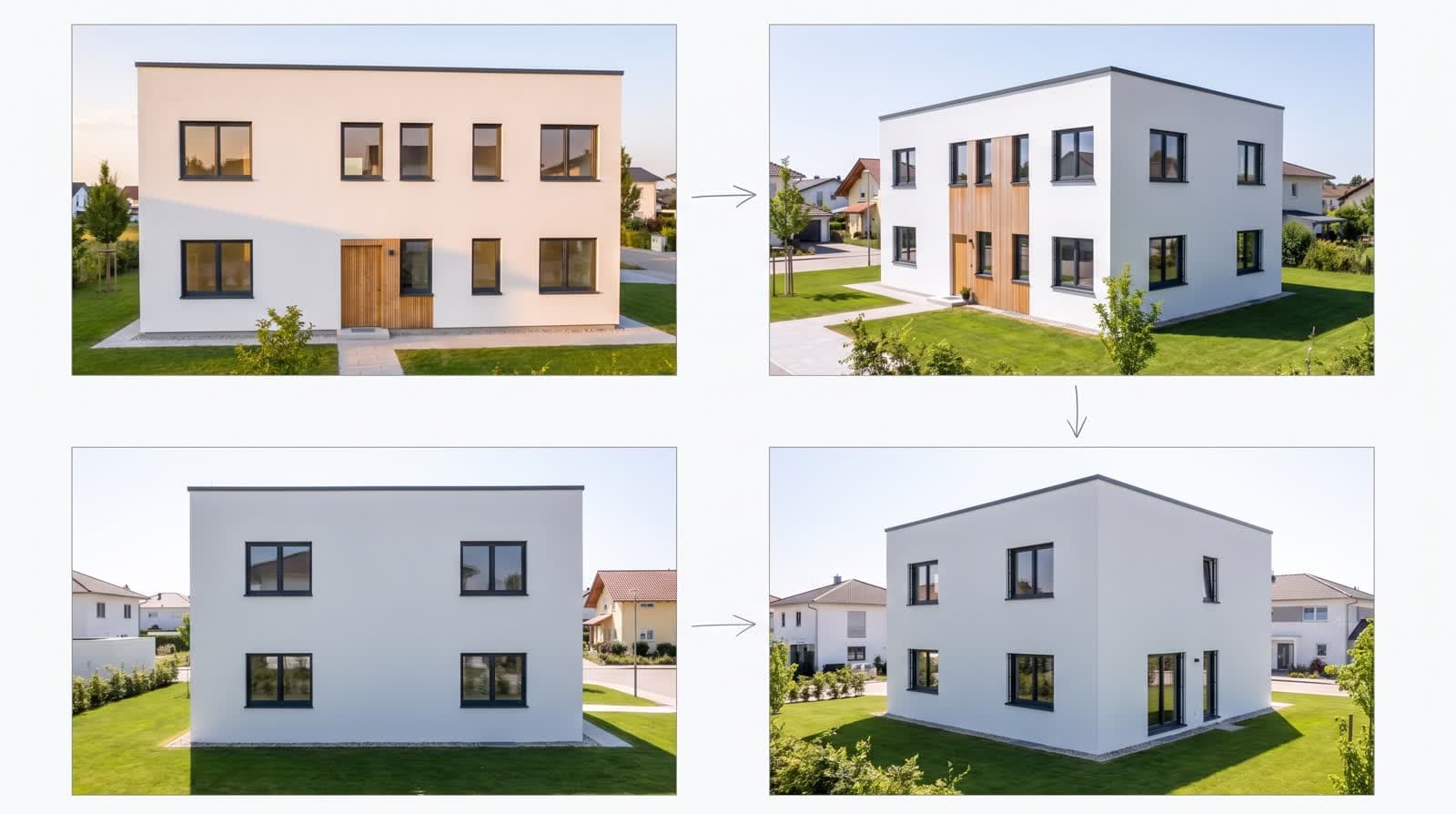
A usable camera flight consists of a few clearly distinct movements: approach, orbit, daylight cycle, interior. Eight seconds per movement are enough to read it; cut together, four of them make about half a minute that people watch to the end. What matters is that each movement answers one question, and that you cut between movements instead of letting them run into each other.
The four movements
Approach
The camera nears the entrance at eye level. Answers: how do you arrive, and how does the building feel when you stand in front of it?
Orbit
An arc around a corner of the building. Answers: how do two facades relate? This clip replaces three still images.
Daylight cycle
Fixed camera, moving sun, light in the rooms at the end. Answers: how does the building change over the day?
Interior
A calm move from the entrance into the main room, towards the window. Answers: how big is it really?
Why eight seconds
Short clips are not a compromise but a property of the technology: video models currently produce sections of a few seconds. For architecture that fits surprisingly well, because a movement is read after about eight seconds. Showing thirty seconds in one take repeats itself.
It becomes worthwhile when several sections are cut together: four clips make roughly 32 seconds that people watch through. When joining without re-encoding, the image quality of each section is preserved.
More movements confuse. A pan across the plot, a zoom on a detail and a drone flight in one clip make a pile of material, not a video.
The arithmetic behind render time
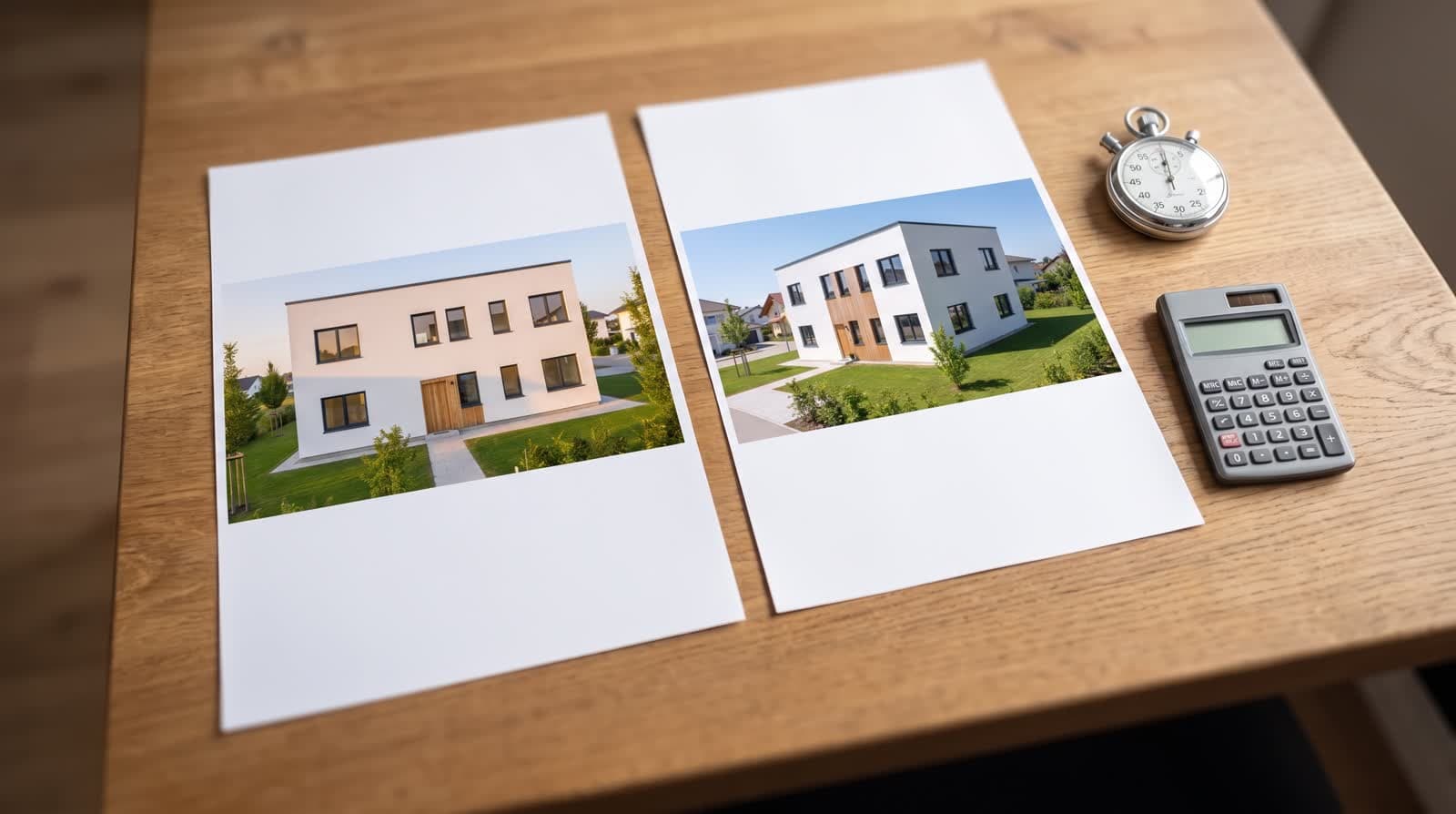
Classic rendering is paid per frame. A flight of 30 seconds at 25 frames per second is 750 individual frames. With a video model, the length in seconds counts, not the number of frames.
Sound, text, music and where the clip runs
- 01Plan without soundMost videos play muted on portals and social networks.
- 02Use text sparinglyA title at the start, one line at the end. Nobody reads more.
- 03No time-lapse for the whole lengthMovement works when it stays calm.
- 04Match the length to the venueOn a project page a film may run forty seconds, because the viewer is already interested. On a portal or in an advert the first two seconds decide, so the strongest movement goes first. In a meeting the clip loops while someone speaks and can be quiet.
Common mistakes and when video is worth it
Movement too fast
What looks brisk in the preview is restless on a phone.
Forgetting eye level
Drone flights show the roof, not the building.
Too many cuts
Four sections, four cuts. More feels frantic.
Wrong aspect ratio
Landscape counts for portals and social networks; portrait only if produced for it on purpose.
Music with a narrator
Explanations belong in the text next to the clip, not in it.
Where video pays off
Marketing, committees (an orbit answers the question of fit in eight seconds) and interiors, where size is easier to judge in motion. For pure design review two images are discussed faster than a film architectural videos.
Questions and answers
How long should an architectural video be?
Between 15 and 40 seconds. Four sections of eight seconds each are a good rule of thumb; anything longer is rarely watched to the end.
Can I join several clips together?
Yes. Several sections can be concatenated without re-encoding when resolution and frame rate match, so the quality of the single clips is preserved.
Does a video need music?
Not necessarily. Most playback is muted. If you use music, keep it quiet and without a narrator.
What does a camera flight cost?
Eight seconds cost twelve to 29 points depending on quality and resolution. Rendered classically, the frame count and the time on the graphics card count instead.